The TL;DR on Google’s New AI Search Guidelines
Google has finally released its official guidelines for optimizing your website for generative AI features on Google Search. Turns out the winning strategy isn’t LLMS.txt files and “chunking” after all.
It’s creating original, authentic, relevant content that AI bots and search engines can easily find and navigate — aka human-focused SEO.
Or, as Google puts it, “Apply SEO best practices to generative AI search” and "create non-commodity content that's helpful, reliable and people-first”.
That’s good news if you’ve already invested in a solid SEO strategy, but it doesn’t mean everything is business as usual. This post is your TL;DR reference guide for what Google says has changed, what hasn’t and what you actually need to focus on moving forward.
What’s Changed?
According to Google, not much has changed at all in terms of how content is “ranked,” and AI prioritizes the same things that search engines always have. However, it may not seem like it, especially if you’re among the many who saw notable drops in traffic to informational pages following the rollout of AI Overviews.
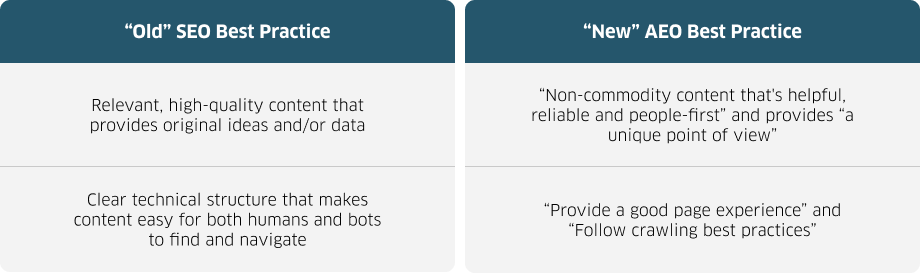
Per Google, the key is “reframing SEO best practices to understand what matters most to AI systems today” and that looks like: Relevant, high-quality content that provides original ideas and/or data (“non-commodity content that's helpful, reliable and people-first” and provides “a unique point of view”) and a clear technical structure that makes that content easy for both humans and AI bots to find and navigate (“Provide a good page experience” and “Follow crawling best practices.”)
So, business as usual, right? Not quite.
Okay, What’s Really Changed?
Google states that “AI features on Google Search are rooted in our core Search ranking and quality systems,” but adds that these features now also rely on AI techniques, including retrieval-augmented generation (RAG) and query fan-out. Both of these techniques leverage Google’s core Search ranking systems, so “ranking well” still improves your chances of having that content served to your target audience. They’re just significantly less likely to click through to your page to read it.
This is where the hard truth comes in: originality matters more than ever.
Yes, from Google Search's perspective, “optimizing for generative AI search is optimizing for the search experience, and thus still SEO…” but if you want to get cited and actually drive people to your website, you have to provide something they can’t find anywhere else.
This is where a truly strategic content plan comes in. What sets you apart from your competitors? What original data can you share? If you don’t have original data, what unique perspective can you offer on existing data?
As Google puts it, “If you're ever unsure about a decision for your site, ask yourself: 'Is this content that my visitors would find satisfying?’ If the answer is yes, then you're on the right track.”
Getting Technical
Something else AI hasn’t changed: If your content can’t be crawled, it can’t be ranked and won’t be seen. Per Google, to be included in AI answers, a webpage should:
- Be discoverable/indexable
- Use the cleanest code possible for user accessibility
- Be careful with advanced visual elements or coding frameworks (like JavaScript), so you aren't accidentally hiding content from Google
- Prioritize a great user experience: load fast, look good on mobile phones and make it instantly obvious to a human what your main content is
- Ditch repeated content: don’t waste Google’s time and distract from your most important content
So, pretty much the same foundational SEO rules we’ve always used, plus making extra sure you’re not making bots work too hard to find things.
What You Don't Need to Change

Google’s AI optimization guide includes a whole section on busting AEO/GEO myths. If you’ve read more than a couple blogs or LinkedIn posts about AEO/GEO, many of these will be very familiar to you, but the TL;DR is: You don’t need to overcomplicate your website or change how you write just to please AI. Google’s systems are smart enough to read your website the way a human would.
More specifically, per Google, you can skip:
- Special AI files like LLMS.txt: A basic, crawlable site is fine
- Secret "AI code" like overly optimized structured data: There is no magical backend code (structured data) that forces AI to pick you
- "Chunking": AI understands content just fine when it’s not chopped into tiny, robotic pieces
- Manufacturing mentions: Planting fake mentions or reviews of your brand across forums and blogs is actually considered spam
- Cramming every fan out query into your content: AI understands synonyms and the overall meaning of what a user is looking for without handholding
Your Audience Is Human
No matter what your business does, humans are the ones who will be using your services and buying your products. Yes, AI helps you connect with those humans, but ultimately, it’s a bridge, not a destination. High-quality, natural content written for real people remains the absolute best way to win in the age of AI search. Even Google says so.

Comments
Add A Comment