How To Design and Build Incredible Digital Experiences in an AI World
Plenty of agencies say they’re human-centered (or if they don’t use that term exactly, say they care about people, or put them first). Most mean it aspirationally, at best. We mean it in practice.
It’s how we decide which projects to pursue, who to hire and where we set the bar for ourselves. It was the founding principle of Nebo back in 2004, and it’s the lens we’re now holding up to the biggest shift our industry has faced since: the shift toward AI.
So when clients, partners and prospects ask us the obvious questions, “How are you going to handle this AI situation?” or “What does your team do with AI?” the answer is short and surprisingly unchanged. There’s an implied friction in those questions, between people and machines, and even between ethics and efficiency.
At Nebo, we aren’t resolving that conflict by changing who we are. We’re resolving it by bringing LLMs, AI and agentic workflows into the way we already work: as participants in collaboration, communication and creation, held to the same or higher standards as everything else we already do.
Workflows will change, capabilities will shift, roles will blur, but that core ethos doesn’t bend. Living up to it right now means rethinking our practice and our craft, deliberately and out loud.
Here are the five major areas where that work is happening.
-
Modality
We don’t treat AI as one thing with a single model. We’ve named three genuine ways we work with it and incorporate it into our day-to-day.
Assistive, which accelerates the thinking behind the work by tying together data and synthesizing documents to help our teams focus on the strategy and creative process.
Collaborative, where it works alongside our team members and extends their craft by providing inspiration, catching mistakes and offering suggestions.
And Generative, where it’s the production tool itself, guided by our strategists, reshaped by our engineers and designers and held to our own standards of excellence.
These shapes aren’t intended to be singular, but rather composable. Any given project might use AI and agents differently and in multiple ways, depending on the needs and the nature of the work. But importantly, we now have a shorthand to talk about those ways of working without having to dive into the nuts and bolts of every specific process.
What Modality Looks Like in the Real World
Our team will always dig in to understand our clients, their audiences, pre-existing research, available analytics and have conversations with key stakeholders and — ideally — real users or audience members.
Now that LLMs are used to synthesize, review and prepare documents and analytics, this process can happen significantly more efficiently. We’re assisted by the technology, but still doing the core of the work ourselves. The mechanical efficiency of AI tools means we have more time for human-centered thought work and strategy.
We’re always faced with the reality of multiple solutions to different challenges: the right way to structure a navigation, the right control surfaces for a complex product UI or the best component use for a given spec. Now, the person leading that work can not only share thoughts with their team, but also directly with an agent as they work, comparing against best practices and innovators and working toward the best outcome collaboratively. “I’ll have to look into…” comments that used to derail brainstorms and reviews are now resolved in minutes with agentic involvement.
Going from “nothing to something” is oftentimes one of the hardest parts of a project. Staring at that the proverbial blank sheet of paper is an age-old creative problem with a variety of solutions. We now have a new way to “just get started” with agentic prototyping.
We can take our informed approach and core design principles, hold a collaborative working session with an agent, and, an hour or two later, have a “sprint zero” completed that gives us the critical thing to react to, fully informed by our direction and guided by our strategy. This generative outcome could be intentionally thrown away at almost no cost, or absorbed and iterated upon to form parts of the eventual end product.
-
Quality
Speed is the easy part with AI. Quality is the discipline and the result of rigor.
“...and make no mistakes” YOLO runs have their place in making a throwaway prototype, proof of concept or sprint zero. But we don’t let that mentality pollute the real process. We remain steadfastly strategy first, architecture first and human first. In practice, that means leveraging the tools for their strengths to enhance their own abilities, using human-shaped patterns.
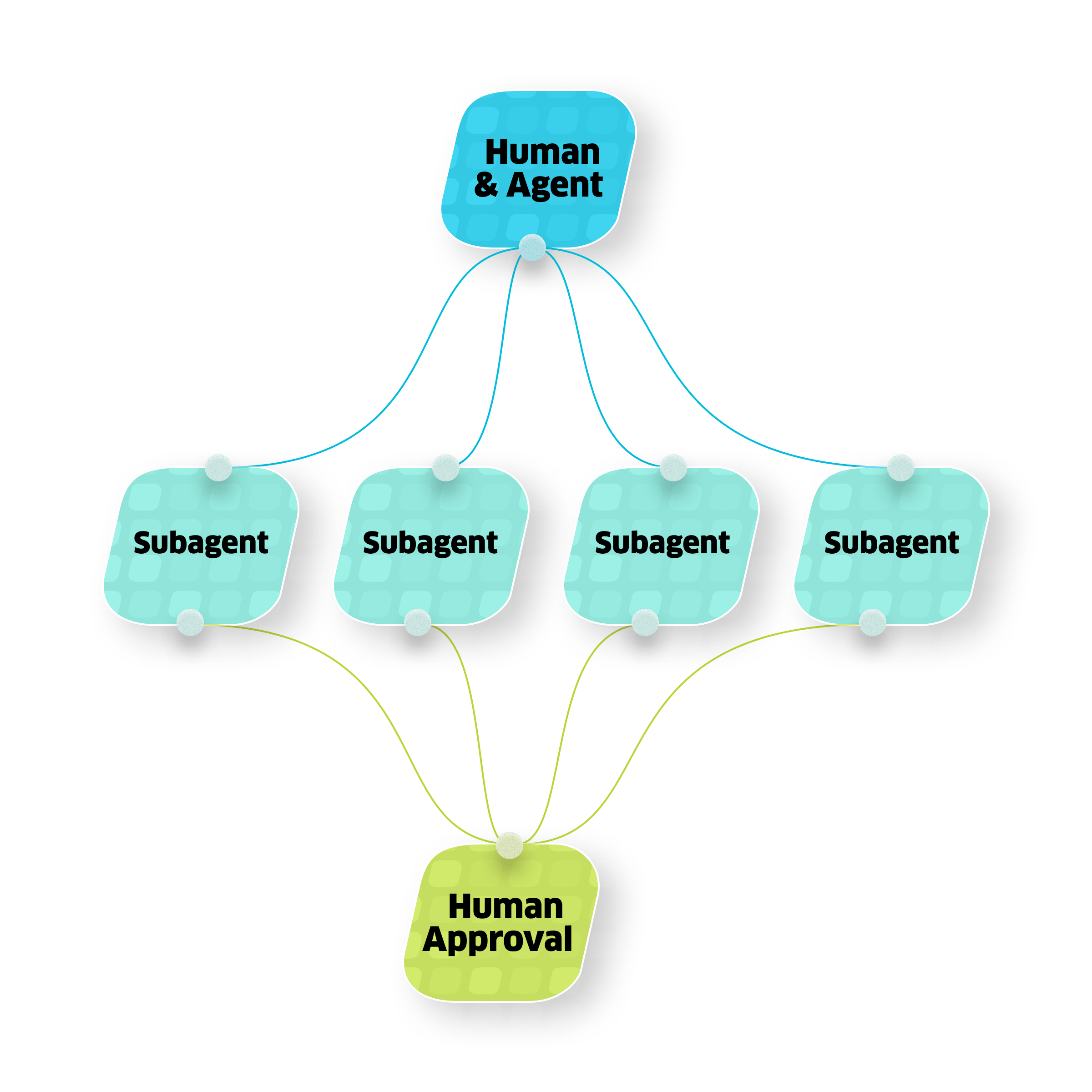
In practical terms, this means diamond-shaped patterns: a single action, followed by multi-agent reviews, followed by deduplication, consolidation and human collaboration. Whether that action is planning for a project or for a feature, code generation or research question, architecture or design, it’s proven itself as an invaluable model.
Diamond-Shaped Patterns in the Real World
We have some shared tooling — Skills, Agents and other markdown files — that we use to maintain a baseline of thorough agent work. One of these is the simple “focus fire” set of Skills, designed for Claude Code CLI.
It begins with planning — literally /focus-fire-plan <something>, which starts a conversation with an agent about what needs to be built and references any pre-existing deliverables or documentation needed. But the resulting agent-and-user plan is actually the midpoint of the skill. Once we’re happy with the shape, the agent will invoke multiple blind subagents, each with a particular perspective and function, to review the plan against whatever context is necessary (e.g., other deliverables, the existing codebase, competitor sites, best practices, etc.).
Those findings are always valuable. They get deduplicated, scored and collaboratively discussed before being incorporated and finalizing the final shape of the plan, which itself is documented as either a shareable document or a build ticket (e.g., GitHub Issue).
What we end up with is a dramatic improvement on the original plan, saving significant time by catching incomplete research, incorrect assumptions or miscommunicated architectural implications before any real work is done. And all of it happens collaboratively, under the instruction and in constant communication with the person directing the work. By the end of the process, they and the team have a perfect idea of what’s being done, how, why and when.
Yes, it costs more in tokens, and costs a little more in wall-clock time. But the result is better, and the process is genuinely more human. The team stays involved throughout, so there aren’t any surprises at the end, and there’s clear ownership over every decision that’s being made, regardless of the scale.
-
Collaboration
Our human-centered mentality means naming challenges when we see them. Suddenly, because of the possibilities of generative code, virtually everyone on our team and our clients’ teams are speaking in code — literally. Increasingly, gone are the quick Fig Jam sketches, the back-of-the-napkin sketch, the “I did my best with PowerPoint” mockups. With agentic tools, TypeScript, Python and other programming languages are increasingly the lingua franca for everyone — not just engineers or analysts — to communicate and share ideas.
It’s a major shift without mature support, and pretending otherwise helps no one. So we’re leaning into it: building the pipelines and the workflows that allow a strategist to generate a landing page prototype and share it as code with a UXer, who can then help develop it and who, in turn, shares it with an engineer, who can prompt its generation and affirm its quality. Multi-artifact waterfall processes have the opportunity to become code-centric, composable, dynamic, iterative workstreams.
-
Client Involvement
Our clients are now a bigger part of the process than ever. What used to be an “I have an idea…” conversation now sounds like “So I had Claude build a prototype…” It’s a good thing, but only if we apply that human-centered lens.
Our clients don’t want to and aren’t giving us build specs, though it’s easy to take that approach. Visual and interactive fidelity is no longer the marker for finality that it used to be.
Instead, creative rigor demands we take them for what they are: conversation starters, finger paintings and rough sketches. Honest attempts to solve for a new inspiration or an unmet desire. And that’s where the real conversation lives: what drove them to build that prototype in the first place? Staying true to our ethos means recognizing opportunities for deeper understanding and for creating a better experience, rather than blindly forging ahead with an execution based on a single late-night thought.
-
Technology
The entire industry is shifting, and platforms have to keep up. We’re re-thinking which Content Management Systems and Digital Experience Platforms we recommend, based on how our clients and we intend to use AI. Those workstreams — in the creation of experiences, maintenance of the systems, or production of additional content — all bend our disposition towards the right tool for the job.
It’s no different on the product side of our work, with MCP support, agent-focused documentation and infrastructure agentic-readiness and resiliency becoming real, observable factors in long-term success.
The human-centered reality here doesn’t change — it just becomes more inclusive of those new ways of working.
Moving It Forward
Across all five of those shifts, the constant is the same: a person sets the intent, a person decides what’s good, a person stays accountable to the audience on the other end.
Our human-centered ethos is the answer to how we do all of this. It was true in 2004, it’s true today, and we’re confident it will still be true in 2034. It’s why we’re keeping our people, growing our team and shifting their roles toward the work that matters most. Our people will make our agentic transformation a success, not be replaced by it.
So we’re raising the bar for agentic excellence, and we’re excited to share how we do it.

Comments
Add A Comment