Good News: SEO Is Alive and Well in the Age of AI

If I hear “SEO is dead” one more time, I’m gonna lose it.
The fearmongering behind AI, LLMs, and the “death of SEO” has to stop. John Lennon settled this in 1971 when he said the war is over. The Star Wars franchise ended it with a party on Endor with the Ewoks (sorry, Adam Driver). And the Avengers laid it to rest once and for all when they defeated Thanos just so Peter Parker could go back to high school.
We’ve seen this play out before. New technology emerges, and suddenly it’s framed as a replacement rather than an evolution. But that framing misses the bigger picture: search isn’t dying, it’s evolving.
We’re living in a digital age where, despite things getting muddier by the day, everything is actually working in harmony better than ever before. Yet, most of our “favorite” SEO influencers in the wild continue to clickbait you with the same question: “Is SEO dead?”
You might still get a couple of slow claps for this one on Internet Explorer, but for the rest of us out here trying to move forward, we’ve got our tomatoes ready to throw.
So I hope you brought your ponchos.
What’s actually changing in the search landscape?
AEO, GEO, AIO… LMNO… GeronimO… whatever you want to call it, it is the next evolution of SEO. A lot of us know this by now, yet we’re still fighting the narrative. Generative search still relies on all of the foundational SEO work you’ve done over the years to survive. Just like John Oates needed Daryl Hall and Michael Jordan needed Scottie Pippen.
Sure, the technical side is more complex. Generative AI and LLMs are doing things like “query fan-outs”, where they take a single prompt and break it down into multiple sub-queries to streamline the search journey into one comprehensive answer. At the end of the day, though, they are following the same fundamental process of crawling and pulling web content as references, just on a much larger scale. This has already been confirmed for platforms like Gemini, ChatGPT, and Perplexity, so why are we still putting up our dukes?
Why Old KPIs Fall Short in 2026
There’s no denying this shift has significantly impacted organic traffic with nearly 60% of searches ending without a click, but we’re not talking enough about why looking at those numbers in a vacuum is a mistake. The truth is that not all traffic loss is bad. How much of this traffic has historically been fueled by informational queries going to your blog, resource pages, or customer service FAQs?
Ahrefs found that navigational and transactional queries only had a 10% chance of triggering AI Overviews (AIO), compared to a staggering 99.2% for informational queries. So I hate to break it to you, but if your conversions are seeing decreases and you think it’s because your blog is down 65% year-over-year, we’ve got a different problem.
SEO isn’t the end-all, be-all that it was 20 years ago, so we need to stop treating and villainizing it like it is. Instead, we should start thinking of it as an additional avenue for brand awareness to work alongside other channels like PR, organic social, and paid media. It’s just one piece of the puzzle. AI models are already looking past your website, using signals like PR mentions and social sentiment to build their own understanding of your brand’s authority. By separating informational noise from high-intent visitors, we can actually determine which traffic is moving the needle and contributing to the bottom line.
This is difficult to do when we’re still trying to rely on KPIs like Total Organic Sessions and Clicks to gauge the success of our entire funnel. We’ve been conditioned to think that if our blog wasn’t bringing in traffic, our visibility was wasted. But in a zero-click world, SEO’s role has shifted. High visibility in an AI Overview might not result in an “Organic” session, but it can often drive Assisted Conversions or a spike in Direct and Referral Traffic when a user eventually decides to seek you out.
Chances are, the informational queries that you’re “losing” clicks on aren’t driving qualified traffic to your website, so let’s encourage some neuroplasticity for a moment and chat through some new KPIs together.
I get it, change is scary. But as SEOs, we’re used to it. To stop fighting these shifts in search, we have to start measuring what actually reflects modern search behavior.
SEO KPIs for the Age of AI-Powered Search
AI Citations
These days, having your content or brand cited by an LLM should be your new north star. This isn’t just about getting a link back to your website; it’s an E-E-A-T (Experience, Expertise, Authoritativeness, and Trustworthiness) signal. When an LLM like Gemini or ChatGPT references your content as its source of truth, it’s a third-party endorsement of your brand’s authority and credibility. You’re creating a strong first impression with audiences, regardless of whether they click through to your site immediately.
Platforms like Ahrefs (Brand Radar) or Semrush (AI Visibility Toolkit) have become essential for snapshots into how our visibility is holding up month-over-month, with detailed trendlines covering mentions, citations, impressions, and AI Share of Voice (the percentage of mentions your brand receives across AI-generated answers compared to your competitors).
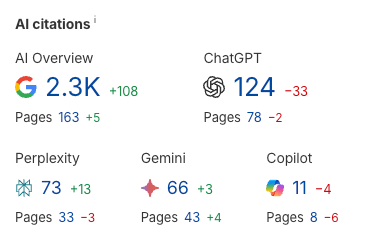
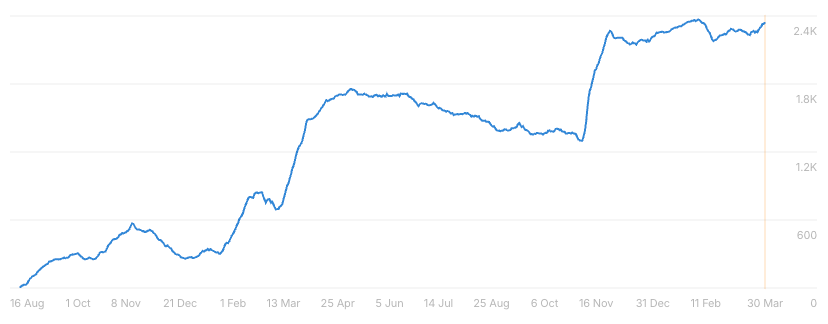
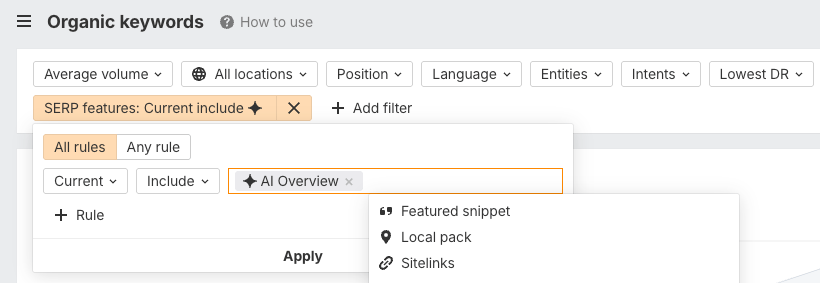
Here’s the cheat code: in addition to the prompts and responses we can get from this data, we can also use the search features filter in the Organic Keywords report to find how many keywords you have that trigger an AI Overview. We can compare this number to the previous month or even the previous year to see how many of your keywords are now driving AI-generated results.
If we set the filter to keywords that previously triggered featured snippets (remember those?) and see how that number has changed over time, I bet you it’s seen an inverse relationship with your AIO-triggering keywords since they’ve started rolling out.
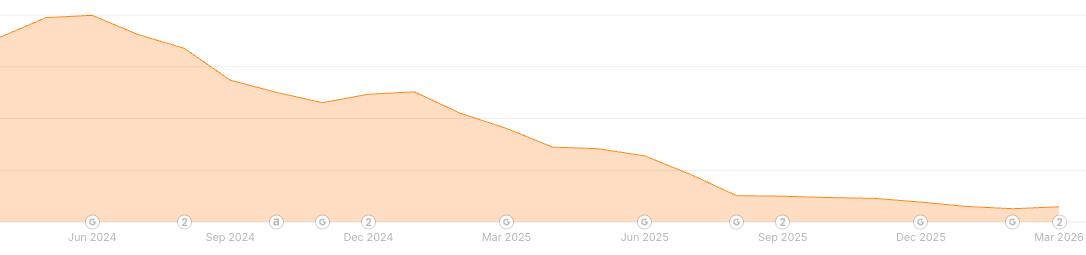
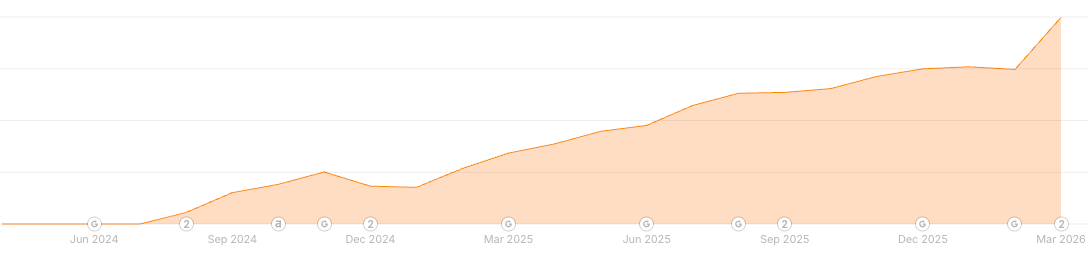
The types of keywords that both features are associated with are the same, and they’re only going to continue growing. I’m not gonna recommend that you present rankings as a KPI, but if you know you’re still holding steady for all of your high-intent keywords and you’re seeing an increase in AIO-triggering keywords and citations, then you’re exactly where you need to be.
What success looks like: Your count of AI-triggering keywords and citations is either growing month-over-month or follows similar patterns as your competitors. Sometimes platform-wide shifts in how topics are searched for can impact everyone in your industry, so don’t be surprised if you see sudden spikes or drops in your trendlines.
It’s important to treat these numbers as directional trends rather than objective statistics, though. There still isn’t any single tool that currently has a 1:1 inventory of every LLM response, and data accuracy can vary across tools. Additionally, these features often come as premium add-ons to your base subscription. If a full suite isn’t in the cards for you right now, manual check-ins on your top 15 high-intent queries can still provide the data you need to validate your visibility and authority. You can run these through Google’s search bar, Gemini, or ChatGPT monthly to track how your brand and competitors are being mentioned and cited, and manually adjust your content strategy as needed to fill any gaps.
Impressions in Different Contexts
Hear me out. I know impressions have historically felt like one of those things where you’re just trying to find anything positive to pull when clicks are down, but the value that they’re able to provide in this new search landscape has fundamentally changed. If a user gets their answer directly from an AI Overview where your brand is cited, you may not have gotten the click, but you did establish your brand’s presence in their journey. By focusing this data in the context of upper-funnel informational content, we can properly contextualize where drops in clicks and clickthrough rate actually matter, and where we can accept the “zero-click” landscape as the new normal for brand discovery.
The Ahrefs-to-GSC pipeline: If we take those informational keywords from Ahrefs and plug them into Google Search Console (GSC), you’ll probably see an expected decrease in clicks but a huge increase in impressions, especially if you created a custom regex filter to isolate content like Blogs or Resources. If it’s indexable and meets Google’s best practices, your content is most likely still visible to people on the SERPs, and, as we saw with the increase in citations, this visibility has grown.
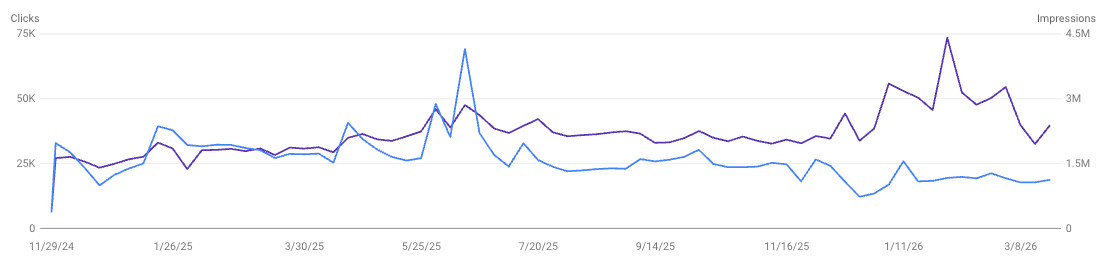
What success looks like: You’re winning if your impressions are continuing to grow even while your total clicks decline, provided that your transactional queries are either holding steady or seeing improvements in clickthrough rate. Evaluating improvements in branded search can help, too; if a surge in “zero-click” impressions coming from informational content is followed by more people searching for your brand or services, your top-of-funnel is doing exactly what it’s supposed to. We can use Google Keyword Planner to gauge how Branded Search Volume shifts month-to-month to benchmark how you and your competitors are doing alongside industry-wide topics and phrases.
It’s important to tell the entire story. Keep your content team and copywriters up on the pedestal and give them a pat on the back. The work they do still matters and is just being discovered differently now. And for other keywords that have more transactional intent, people who are actively searching for your brand or your services still need to visit your site to complete key conversion actions. That game hasn’t changed, and neither AI Overviews nor the LLMs have been able to replicate it… yet.
Assisted Conversions (and Qualified Conversion Rate)
Whether you’re a non-profit or have an e-commerce site for your business, conversions are still your most important KPI at the end of the day. As I mentioned before, people still need to visit your site to complete key engagement actions that can’t be handled within search results.
If a user learns about your brand through a cited AI response, but eventually returns via Direct or a Paid Social ad, that is an Assisted Conversion. We can see these conversions in context in GA4 (under Advertising > Key events attribution paths). If we continue to look only at total organic sessions and how they translate to organic conversions, we’re ignoring the influence SEO has on every other channel in the mix.
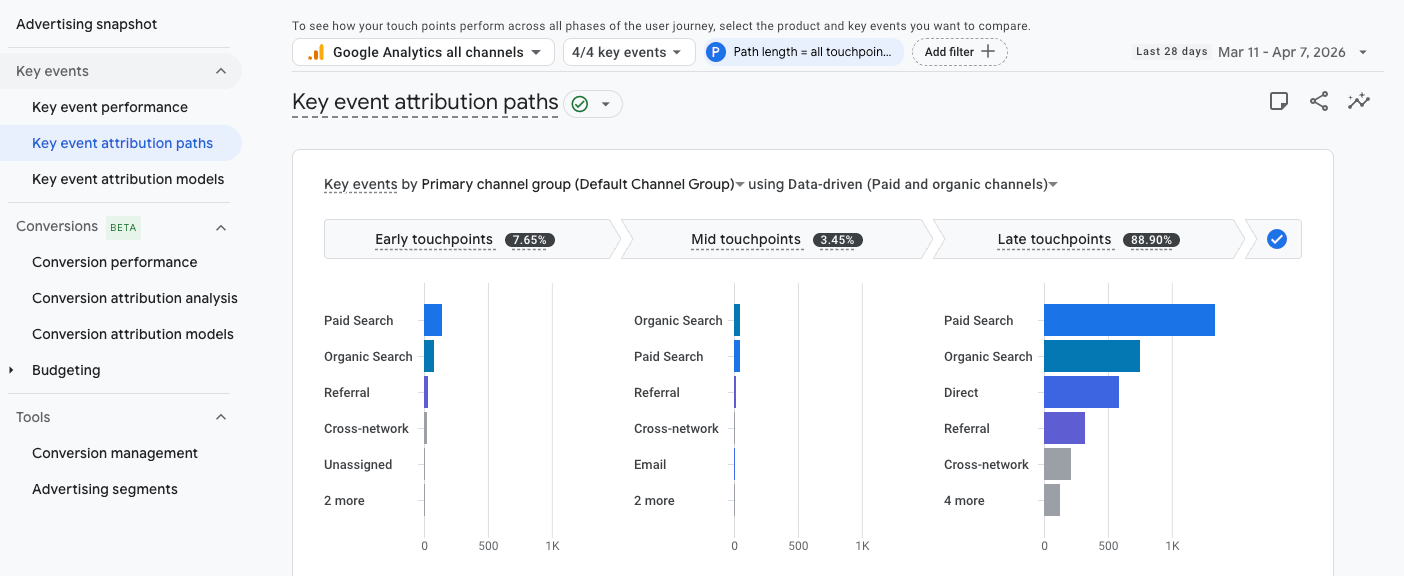
Filtering out the noise: As far as your reporting is concerned, it might be helpful to evaluate your organic performance based on pages that are solely intended to drive conversions. This will help you find your Qualified Conversion Rate. Assuming your rankings and visibility have remained the same, your conversions across the site should still be mostly steady, and the conversion rate will be more truthful if it’s not accounting for your informational content. If a user always had zero intention to buy and was only looking for a quick answer to their search, their click was just a vanity metric that was skewing your numbers. So you can go ahead and ignore that top-performing blog covering office jokes if your primary goal is to sell staplers.
What success looks like: Context is everything. If the traffic to your product and service pages is up, and your conversions on these pages are doing well, then you’re doing exactly what you need to. If your visibility and traffic are up, but conversions are down, then maybe it’s time to evaluate why people aren’t able to move through your conversion funnel. And lastly, how we view assisted conversions through Direct, Referral, and paid media matters. The net total outweighs the performance of any one channel every time. Again, SEO is just one piece of the puzzle.
Looking Ahead
At the end of the day, it's night. Just like SEO has to evolve, the way you view its success does, too. Stop mourning the "loss" of clicks from people who were only looking for quick answers with zero intention of engaging further. Those sessions were never going to contribute to your bottom line.
In 2026, we're trading short-term traffic for long-term authority and high-intent visibility, and we have the resources to help us find where the value still is. By using the tools and filters we’ve discussed to hone in on these new KPIs, we can finally separate vanity metrics from the data that actually matters. So take a deep breath, burn the “SEO is dead” sign you have in your front yard, and burn the other ones that you were planning to put out over the next 20 years.
It’s time to stop looking at what’s missing in your analytics reports and start focusing on the qualified audiences who are still willing to click through all of the noise to find your brand. SEO’s already moved on to bigger and better things. Maybe you should, too.

Comments
Add A Comment