AI Didn’t Kill SEO—It Made It Matter Again

SEO is changing… again.
But this time, it’s not just a tweak to the algorithm or a new best practice. It’s a fundamental shift in the way people find information in the first place.
For the past 25 years, search has followed the same basic playbook. You typed something into Google or Bing, scanned a list of links, snippets, videos, and “people also ask boxes”, and clicked your way to an answer. Brands optimized to rank. Consumers skimmed. The interface evolved, but the underlying model stayed the same.
That model is now breaking.
People aren’t just searching anymore – they’re asking. And increasingly, they’re getting answers without ever seeing traditional search results. AI-powered experiences like Google AI Overviews, ChatGPT, Gemini, and other generative tools have effectively introduced a new kind of search engine. One that doesn’t just surface information, but interprets, summarizes, and presents an answer with confidence.
Naturally, this shift has sparked a fresh round of acronym anxiety: AEO. GEO. LLMO.
And with it, the question everyone is asking: What happens to traditional SEO in an AI-driven world?
Our answer: SEO isn’t going anywhere. In fact, all this change has made SEO more relevant than it’s been in years. But it’s no longer the whole story.
Let’s be clear: AEO and GEO aren’t replacements for SEO. They’re the next iteration of it.
SEO remains foundational. What has changed is that AEO and GEO represent a new channel layered on top of it, with different mechanics, success signals, and strategic considerations.
Acronym Decoder (No Panic Required)
SEO: Search Engine Optimization
You know this one. SEO is the practice of optimizing websites to improve visibility in search engine results pages (SERPs) like Google and Bing, with the goal of driving relevant organic traffic.
We won’t belabor it; you’ve got this part.
AEO: Answer Engine Optimization
AEO is about optimizing for search experiences that provide direct answers, not just a list of links. It’s about how content wins a specific answer. This includes featured snippets, voice assistants, and AI-powered summaries and answer boxes.
The real shift here isn’t technological. It’s strategic.
In the old world, the goal was to rank #1 and enjoy a 33% click-through rate. Then came the in-between era. Search engines began surfacing one “best” answer directly on the results page in the form of featured snippets and direct answers. AEO, at this stage, was about winning the answer. Not just ranking, but being the single source Google trusted enough to feature.
In the new world, the goal is to provide such a clear, authoritative answer that the engine uses your content to answer the question. Sometimes, before a click ever happens.
Welcome to the zero-click reality. Many users now get what they need directly on the results page. That might sound scary, but being the source of the answer is a powerful form of visibility, even when the click doesn’t come immediately.
GEO: Generative Engine Optimization
GEO takes things a step further. It’s the practice of optimizing content for all generative AI experiences, not just Google Search. It’s about how brands become a recurring source for many answers.
Despite how it’s often framed, GEO is not synonymous with Google AI Overviews.
It includes conversational AI like ChatGPT, Gemini, Claude, and others, AI-powered summaries and assistants, and any interface where AI retrieves, synthesizes, and presents information.
This is also where LLMO (Large Language Model Optimization) often enters the conversation. LLMO focuses more narrowly on how content is structured, framed, and contextualized so that large language models can interpret and reuse it accurately. In practice, this isn’t a separate strategy but rather a subset of GEO.
In other words, GEO is about thinking beyond the search bar.
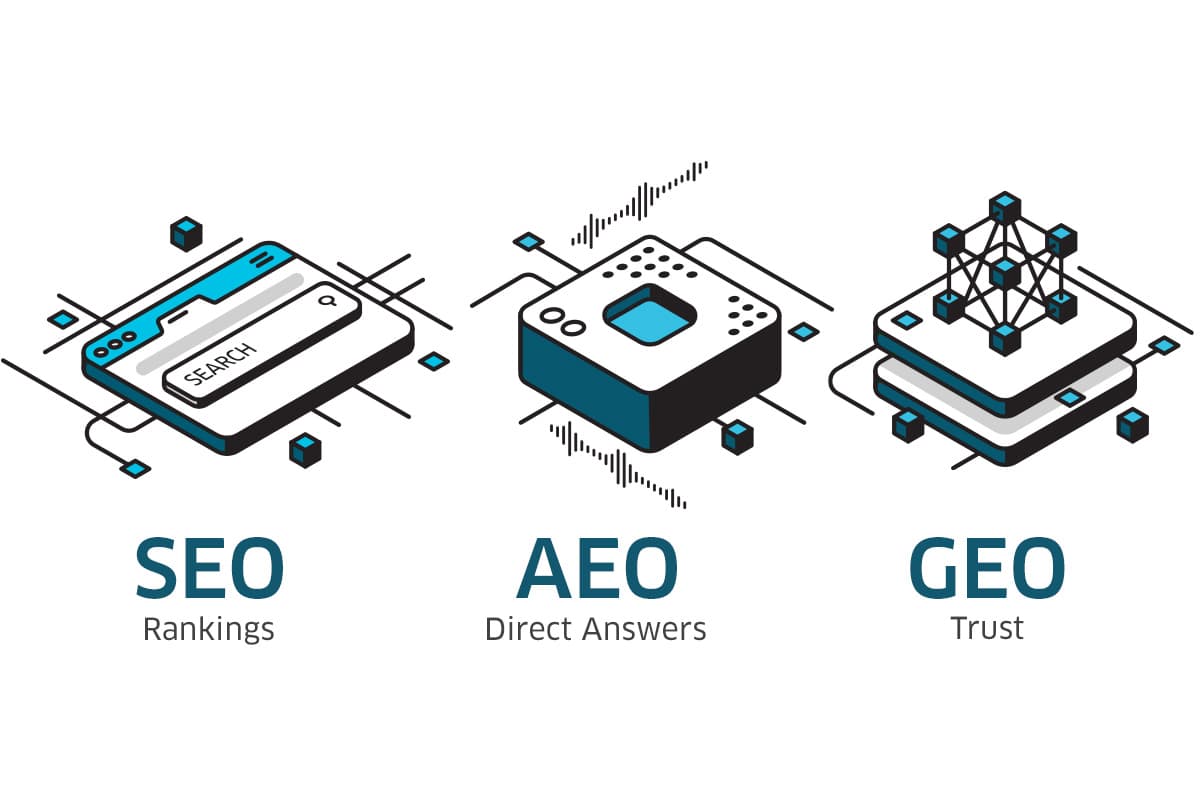
The web is no longer just built for humans. We’re now creating content that needs to be easily understood, extracted, and reused by intelligent machines—without losing credibility or nuance. In terms of GEO, the goal is to provide such a clear, authoritative answer to the immediate question—as well as a substantial number of related questions—that the engine uses your content to provide an answer.
Why This Shift Matters
AI Overviews didn’t come out of nowhere. They’re the next logical step in Google’s decade-plus effort to understand intent, from Hummingbird to RankBrain to BERT to MUM. What’s changed now isn’t just Google’s ability to understand what you’re asking, but its growing ability to anticipate what you will ask next.
Search is actively moving from “help you find information” to “give you the answer right now” and, ultimately, predicting the overarching search journey. At the same time, large language models are going a step further and delivering not just an answer, but context, comparisons, and anticipating follow-up questions.
That has real consequences:
- More queries are answered without a click
- Organic listings are pushed further down the page
- Competition now includes YouTubers, TikTok creators, Reddit threads, and forum posts—not just websites
- Authority is expanding beyond the traditional, domain-only model
But here’s the part that gets lost in the panic: AI didn’t replace search; it’s built on top of it.
Large language models don’t magically know things. They rely on search engines to retrieve information and then summarize it, essentially acting as a search proxy. Google has also confirmed that Gemini, AI Overviews, and AI Mode are grounded in Google’s search index to ensure reliability and reduce hallucinations.
Translation: if your SEO foundation is weak, your content won’t show up anywhere. AI included.
How AI Search Actually Works
One of the biggest differences between traditional search and generative AI search is something most users never see: query fan-outs.
In traditional search engines, a query triggers a relatively straightforward process: the engine retrieves a ranked list of results based on relevance and authority. One query at a time, one results page at a time.
Generative search works differently. When someone asks a question in ChatGPT, Gemini, etc., that single prompt often explodes into a dozen related queries behind the scenes. The system will break a question into multiple related angles, definitions, comparisons, and follow-ups, parsing all of the relevant information at once. This is what we mean by a query fan-out.
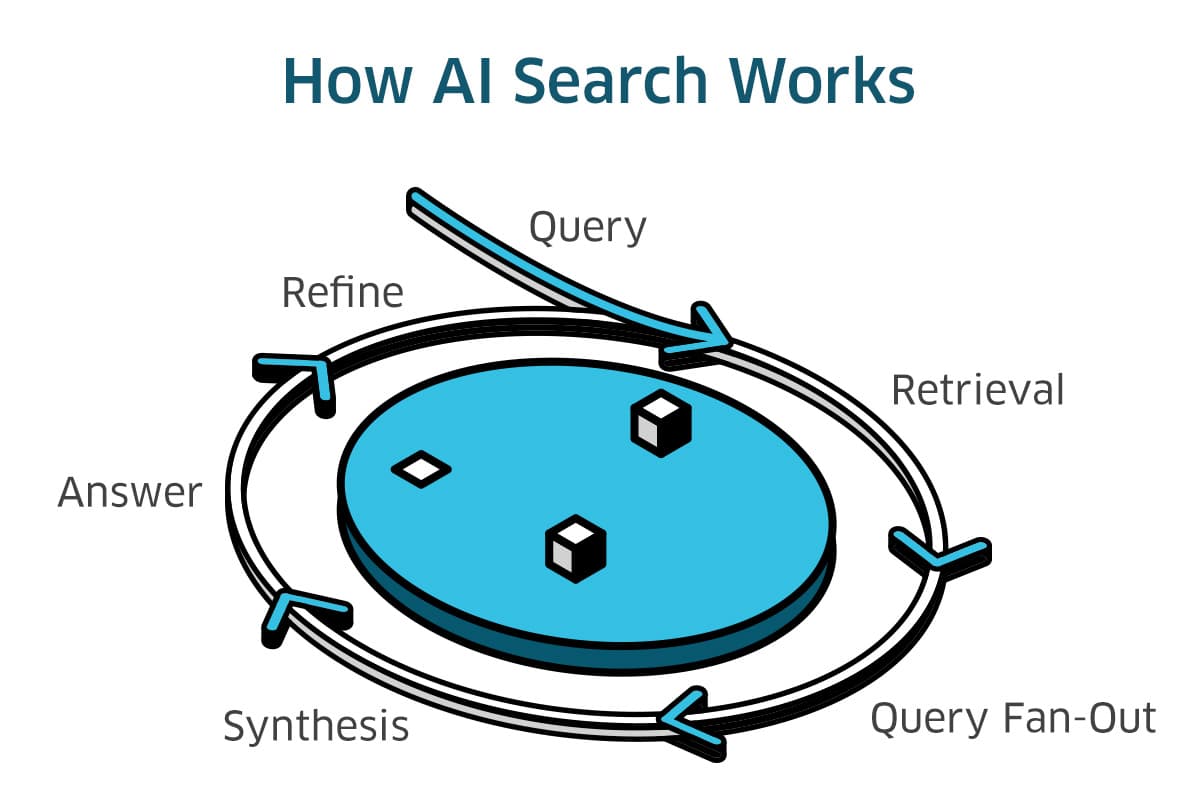
Why does this matter? AI isn’t looking for one perfectly optimized page. It’s looking for patterns of credibility across a topic.
If your brand only shows up for one narrow keyword, you’re easy to miss. But if you consistently appear across related questions, explanations, and supporting concepts, AI systems are far more likely to pull from your content when synthesizing an answer.
Just as important: what that content contains.
Think back to writing a research paper. You only cite sources when they offer something that isn’t common knowledge, like original data, a distinct POV, or firsthand insight. AI systems work in a similar way. If your content simply resembles broadly available information, heavily cites outside sources, or worse, mirrors what generative AI can already produce, then there’s little reason for it to be surfaced or cited.
First-party data, original thinking, and real-world experience are what differentiate content in a query-fan-out environment. As AI evaluates dozens of related questions at once, it doesn’t just reward relevancy; it rewards contribution.
The SEO Ripple Effect
Think of SEO as the infrastructure. AEO and GEO are the new distribution layers built on top.
All the work brands have invested in SEO over the years is now the prerequisite for visibility in AI-powered experiences.
What’s changing:
- Success Metrics: As brands see consistent declines in traffic and clicks, citations and visibility still matter
- Ranking Mechanics: You can still “rank” by being referenced or cited
- Content Formats: Video, UGC, and multimedia content can now be the source material, and content structure is paramount
What hasn’t changed:
- Authority still wins
- Quality still matters
- Trust is still everything
The fundamentals remain—but the strategy for applying them is evolving.
The SEO Pillars That Matter More Than Ever
E-E-A-T (Experience, Expertise, Authoritativeness, Trustworthiness)
This is table stakes. Generative AI tools are designed to pull from credible sources. Without strong E-E-A-T signals, your content won’t even be considered.
Technical SEO
Fast, mobile-friendly, well-structured sites are easier for humans and AI to crawl and understand.
Inbound Links
High-quality links still signal authority and trust. These are critical factors for both rankings and AI citations.
Yes, these should all be familiar. But the way they compound and where they show up is different.
For example, creating a content pillar and topic cluster strategy has historically meant building a strong hub page supported by related content to improve rankings across a keyword set. Today, that same structure now fuels query fan-out targeting, ensuring that your brand shows up across the many sub-questions AI generates behind a single prompt. The goal shifts from owning a topic page to consistently appearing wherever the topic gets broken down, reframed, and reassembled.
The same evolution applies to non-traditional search channels. YouTube, Reddit and social channels now function as search engines in their own right, and generative AI pulls from all of them at once. Optimizing these channels used to be about performance in isolation. Today, it’s about collective authority; not optimizing channels separately, but designing them to reinforce the same expertise in generative search.
The Measurement Gap No One Has Solved…Yet
As teams adapt to this new era, most SEOs find themselves explaining a growing disconnect: “CTR is decreasing, impressions are up, but visibility matters!”
What often goes unsaid is that we do not yet have a clear way to prove the value of visibility in generative AI models.
Being cited does not guarantee clicks and traffic. Brand lift is a lagging indicator and hard to attribute. And AI visibility shows up everywhere and nowhere in traditional analytics.
There’s no shortage of shiny new tools promising insight into AI citations, rankings, and generative engine exposure. But the reality is that accuracy, consistency, and long-term reliability are still very much open questions.
For a long time, SEO success fit neatly into dashboards. AEO and GEO disrupt that comfort. We’re moving from direct attribution to influence, and that shift makes a lot of teams uncomfortable.

Luckily, SEOs have navigated this type of disruption before (looking at you, “keyword (not set)”). We’ve been here before when the metrics broke, which means we already have a playbook for operating in the messy in-between.
As with past shake-ups, now is the time to align on meaningful KPIs, and cut the fluff and vanity metrics. That means stepping back from channel-specific reporting and looking at performance holistically: how organic search influences social, how social fuels PR, and how all of it contributes to direct and total site traffic. The old attribution model SEO no longer works, and the path forward requires measuring impact, not just isolating a single channel.
How Search is Building Memory
To understand why authority matters more than ever, we need to talk about how generative search actually “remembers” information.
Traditional SEO trained us to think in moments: this query, this ranking, this click.
Generative search doesn’t work that way.
AI-powered search experiences don’t just retrieve information in real time. They learn patterns over time. They recognize which sources consistently provide clear, accurate, and trustworthy answers, and they begin to rely on those sources again and again. And if users are logged in and using tools like ChatGPT, the answers they receive are even more personalized based on historical conversations.
This is what we mean by Search Memory.
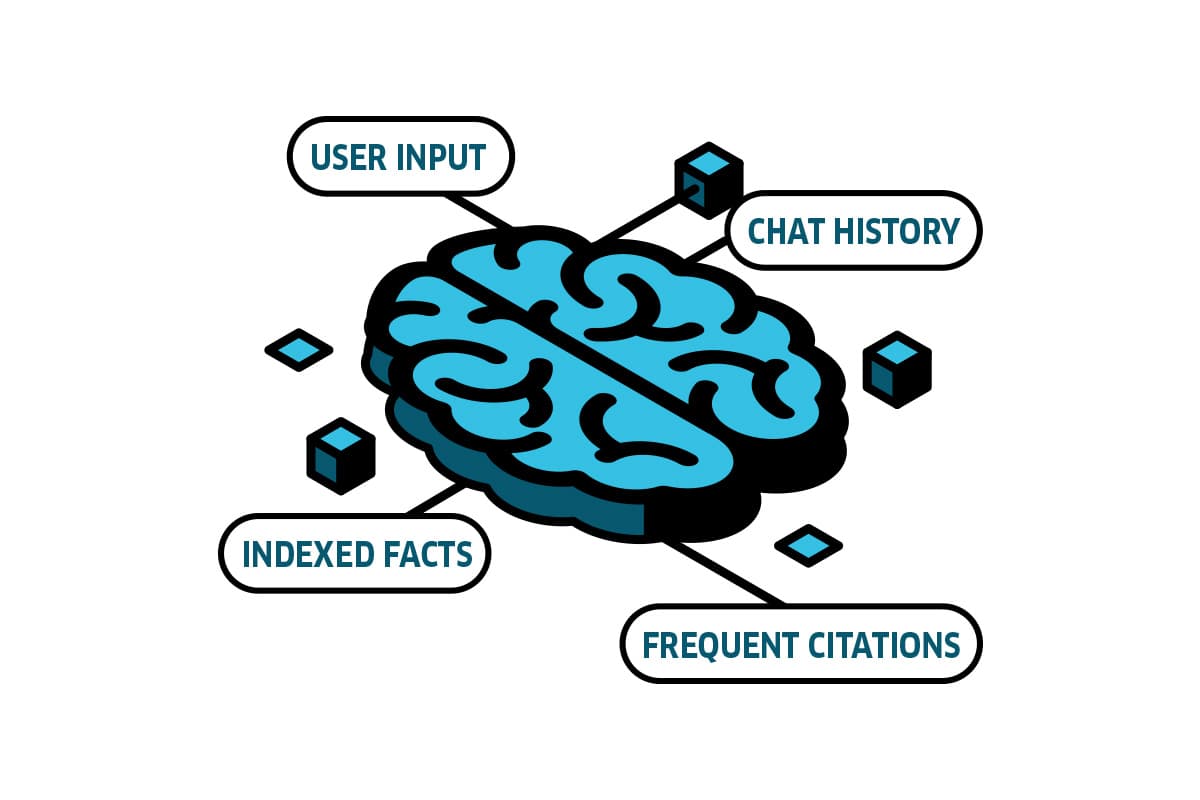
Instead of competing for a single ranking on a single query, brands are now competing to become the source that AI systems remember, trust, and rely on. Once a brand establishes itself as a reliable expert on a given topic, it’s more likely to be cited repeatedly across related questions. Sometimes even when it’s not the most recently published or aggressively optimized result.
That’s a fundamental shift.
In this new search landscape, consistency and clarity compound. AI rewards brands that show up again and again with aligned messaging, real expertise, and content that’s easy to extract and summarize without losing meaning.
There’s no single page, schema type, or AI-optimized template that guarantees recall. Search Memory is earned through repetition, reliability, and restraint. It’s earned by publishing fewer things better, and by showing up as the same credible voice every time.
In other words, the future of SEO looks a lot less like chasing rankings and a lot more like building reputation. And that might be the most “old-school” idea in this entire conversation.
The Bottom Line
AEO. GEO. LLMO. Call it whatever you want. But don’t treat it like business as usual.
These aren’t just new acronyms for SEO. They represent a new channel, built on familiar principles, but governed by different dynamics.
SEO is evolving from ranking to being the answer. Brands that win in this new era will be the ones that double down on fundamentals, build real authority, and create high-quality, structured content that works for both humans and AI.
Same foundation. Bigger stage.

Comments
Add A Comment