The secret to great marketing isn't really a secret.
The problem with a lot of marketing is that it tries to say too much, and it ends up saying nothing. Good marketers figure out which market is uncontested and which aspect of their brand story is the most compelling to the market. Then they create simple messages that communicate their brand story, and embed those messages in the minds of their potential customers.
Most marketing literature over the last four decades revolves around this single topic. Al Ries & Jack Trout called it Positioning. Seth Godin referred to it as the Purple Cow. The Harvard Business School said it's not marketing 101, it's advanced business strategy and they rebranded it the Blue Ocean Strategy. The HBS even created matrices and strategic frameworks (complete with acronyms) to make Blue Ocean Strategy appeal more to analytical thinkers. But, these books pretty much all say the same thing. They say the key to growing your company is to find an uncontested market space, create a simple message that communicates that fact and own that market space in the mind of your consumers. And they're right. That's the secret to great marketing.
But, what makes marketing hard is that most companies aren't unique. There are always more "me too" companies than there are remarkable ones. And, unfortunately, if you're not a market leader or the first in your particular niche/space—you're a "me too" company.
So how does a "me too" company create great marketing? They have two choices. They can shift their strategy, focus on a corner of the market and become dominant in that space by identifying an aspect of the product that other companies are ignoring (AKA -- they can become remarkable, find a unique position, or identify a blue ocean). This is the Volvo method. When others car companies focused on fast/comfortable/fun. They focused on safe, and grew because of it.
The other option is to take advantage of new/emerging media and become dominant in that medium while the bigger competitors are slow to adopt. It's not a market opportunity, it's a media opportunity. This is the burma shave method. Burma Shave recognized in the 1920's that cars were playing a much bigger role in people's lives, and they took advantage of this new roadside medium with a campaign that placed a series of rhyming signs along all the major highways. Obviously, the same thing is happening today in all corners of the web (facebook/twitter etc). Those that are the first to take advantage of the opportunities win. Companies that leverage the web have huge a advantage over their competitors.
The secret to great marketing isn't really a secret. So, whether you decide to become a purple cow, own a unique position, or sail to a non-competitive blue ocean—all you're really doing is finding a marketing opportunity and taking advantage of it.
Changing in The Dark
There is always a risk in changing. Sometimes it's possible to measure the risk and calculate the value of taking or leaving it, but sometimes changes are made in the dark-- the risks are unmeasurable or unknown. At the heart of all customer, fan, and audience reactions are a slew of stored up emotions, expectations, and desires. Psychology can be a useful tool in marketing, but unfortunately psychology cannot ascertain the future or perfectly predict the predictably irrational human psyche.
The Truth About Agency Blogs, Even Ours
In the world of interactive marketing, the hubs of conversation are most definitely not agency blogs. For all of the talk about embracing web culture, understanding content creation, and taking the dive into social media, there is a gaping lack of collaboration and interaction between digital agencies. We're creative folks with our minds on big things. We understand the new economy, the new technology, and the precise future of advertising. We understand pretty much everything except how to take our critical lens off of our clients and off of media to reexamine ourselves.
The lack of interaction on agency blogs is appalling: no guest posts, rarely @replies on Twitter, and, not surprisingly, a lack of comments on posts. Most of the posts on agency blogs are vain attempts at gaining thought leadership. Of course, very little is actually gained. When a thousand arms reach for the pie in the sky, no one gets very much.
Build Links Like Google
That’s right, Google does a great job at consistently building links with clever, unique, and fun link building tactics. Sure, it’s a lot easier when you publish a single blog post to 501,000 subscribers, but Google remains hungry when it comes to dominating its own search results (and others) for its products and services using well thought out SEO campaigns that attract a lot of links.
How understanding natural biases can make you a better colleague.
Everyone uses cognitive biases to speed up their decision making process. They are as old as decision making itself. The most common bias is "confirmation bias." It's a great description for the tendency of people to blindly accept evidence that supports their theory, but hold in great skepticism anything that undermines their theory. If you've ever read something in order to prove your point in an argument, then you're most likely guilty of confirmation bias.
Why does this matter to you? After all you're a marketer, an entrepreneur or a web guy, not a researcher. It's important because everyone is a decision maker at some point in their work and if you're not aware of the biases that effect you, then you can't be proactive in overcoming them.
The Problem with One Identity
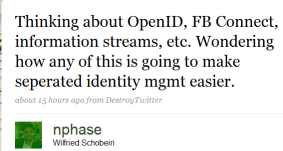
One of my good friends, Wilfried Schobeiri, wrote me an e-mail a few days ago about a trend in social media. He writes:
I was thinking today about OpenID, Facebook connect, twitter's connect thing, Google, friend feed, etc...Twitter shows my thought process: