We’re Returning to an Oral Culture—And the Rules of Reality Are Changing
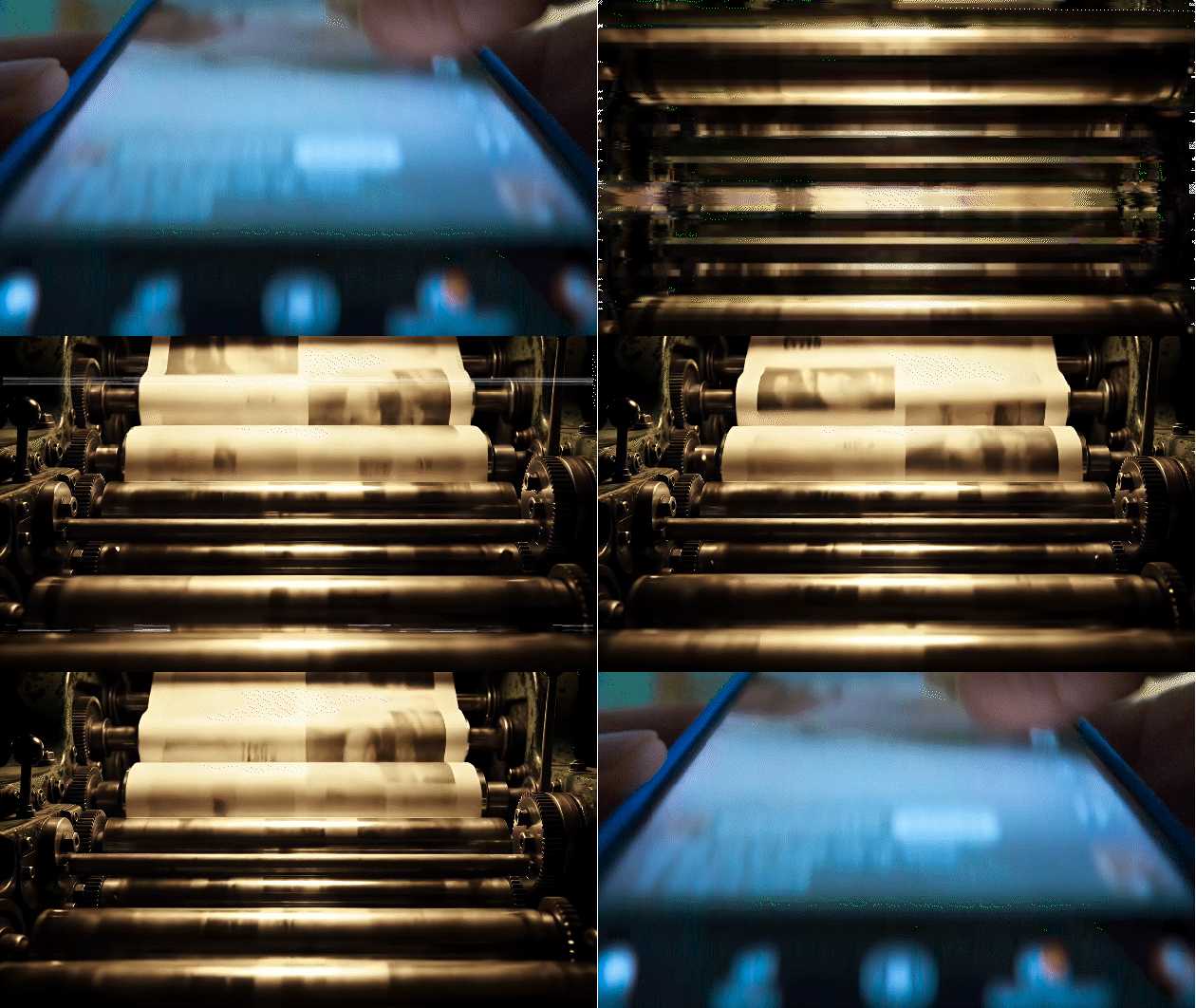
We tend to view history as a straight line of progress: an evolution from primitive to modern. But, new technology often causes us to retrieve past forms of culture in unexpected ways.
In the mid-70s, philosopher Marshall McLuhan proposed the Law of Reversal, arguing that when a medium is pushed to its extreme limit, it doesn’t just break — it flips into its opposite. While the internet started as a media channel focused on the written word (hypertext), it didn’t bring in a new literary age. Instead, the proliferation of text has overheated the system and reversed into what Walter Ong called "secondary orality" — a state where electronic media recreates the immediacy and group-think of pre-literate cultures. Today, media analyst Andrey Mir calls this "digital orality."
For 500 years — roughly from Gutenberg’s press to the rise of the internet — we lived in a literary culture. This era prized reading, linear and rational logic, and objective facts.
But, it turns out, that era was an anomaly. And now it’s over. The Great Reversion is here, and oral culture is on the rise. This isn’t just academic theory. It’s a warning that the rules of communication are being rewritten, and to survive this shift means understanding why “vibes” and “aura” are more than just slang.
Literary Culture Is Fading & Oral Culture Is Rising
If you were born before 1990, your concept of media (like my own) is rooted in a culture that no longer exists. The world is divided into factions without a shared source of truth. Social consensus and the shared emotion of the collective are more important than factual information. News increasingly validates feelings rather than informs its audience.
While many lament that this shift is unprecedented, it was predicted by modern media theorists, and our current cultural era is really just a reflection of the dominant mediums of communication: the internet and, increasingly, short-form video.
Before Gutenberg ushered in the literary era, human history was oral. Truth was based on group consensus, not written fact. Oral conflict was the method by which ideas were processed. Performance (how they said it) mattered as much as content (what they said), and everyone was both a broadcaster and a consumer. What makes this iteration of oral culture unique is that it exists on a global scale.
The friction we feel today — the polarization, the death of nuance and the distrust of institutions — is the result of the world shifting from an operating system based on literary culture back to one based on oral culture.
Memes as Information Signals
Perhaps the earliest indicator of the rise of oral culture was the growth of the meme as a dominant form of media on the internet.
Memes act much like folklore and myths. They are a shared reference point that conveys compressed packets of cultural meaning. They are totems that represent a shared reference point in culture and quickly communicate a core idea about a person or situation. Memes aren’t just internet noise. They are part of a vocabulary of the new age of orality.
Vibes as a Form of Verification
Vibes also play a role. In a world in which access to information and content is basically unlimited, “facts” have lost much of their power of persuasion. Instead, we rely on the collective mood of our social peers.
Vibes have supplanted data in driving collective behavior. Vibes drive economic and political outcomes in a way that feels almost unprecedented (recall the litany of thinkpieces on the “vibecession” not too long ago). Vibes aren’t just an aesthetic. They’re a mechanism of verification in an increasingly oral culture.
Aura as a Prerequisite to Leadership
We’re also entering a new era of social status. In literary culture, status and authority were bestowed by institutions and credentials. Positions of leadership and audiences were granted to those whose credentials and ideas best matched the role they were supposed to fill.
However, in oral culture, leadership relies more on the skills of charismatic performance than on the accumulation of credentials and clever policy ideas. This is a return to the pre-modern idea of leadership as a performance, not a position.
Aura, the ability to be charismatic and engage an audience, matters more than credentials and ideas in an increasingly oral culture. Aura isn’t just a performative presence. It’s now a key signal of social status and will increasingly be a prerequisite to success in the modern era.
The Result Is a New Operating System for Culture
If you want to succeed in the current media era, you have to get comfortable with the idea that much of what has happened over the past 10 years isn’t an aberration. It’s an evolution of the underlying operating system of culture.
| Literary Culture (Fading) | Oral Culture (Rising) | |
| Collective Behavior | Driven by Data | Vibes |
| The Purpose of News | Inform | Validate Feelings |
| Verification of Truth | Third-Party Fact Checking | Group Consensus & Acceptance of the Story |
| Social Status | Credentials | Aura |
We’re in an age of digital orality, and the rules have changed. Whether we like it or not, many of the primary tenets of literary culture are fading and oral culture is on the rise.
We cannot unlearn the logic and science of literary culture — nor should we. The trick of the next decade will be maintaining the discipline of the "literate mind" (logic, facts, depth) while mastering the tools of the "oral world" (narrative, charisma, group consensus).
The winners will be those who can shape consensus and shift vibes — creating a sense of identity and a shared mission that is bigger than the individual. The future belongs to those who can harness these tools to build and lead a community.

Comments
Add A Comment