Entering the Chat: Comparing the Top AI Visibility Tools for Your Brand

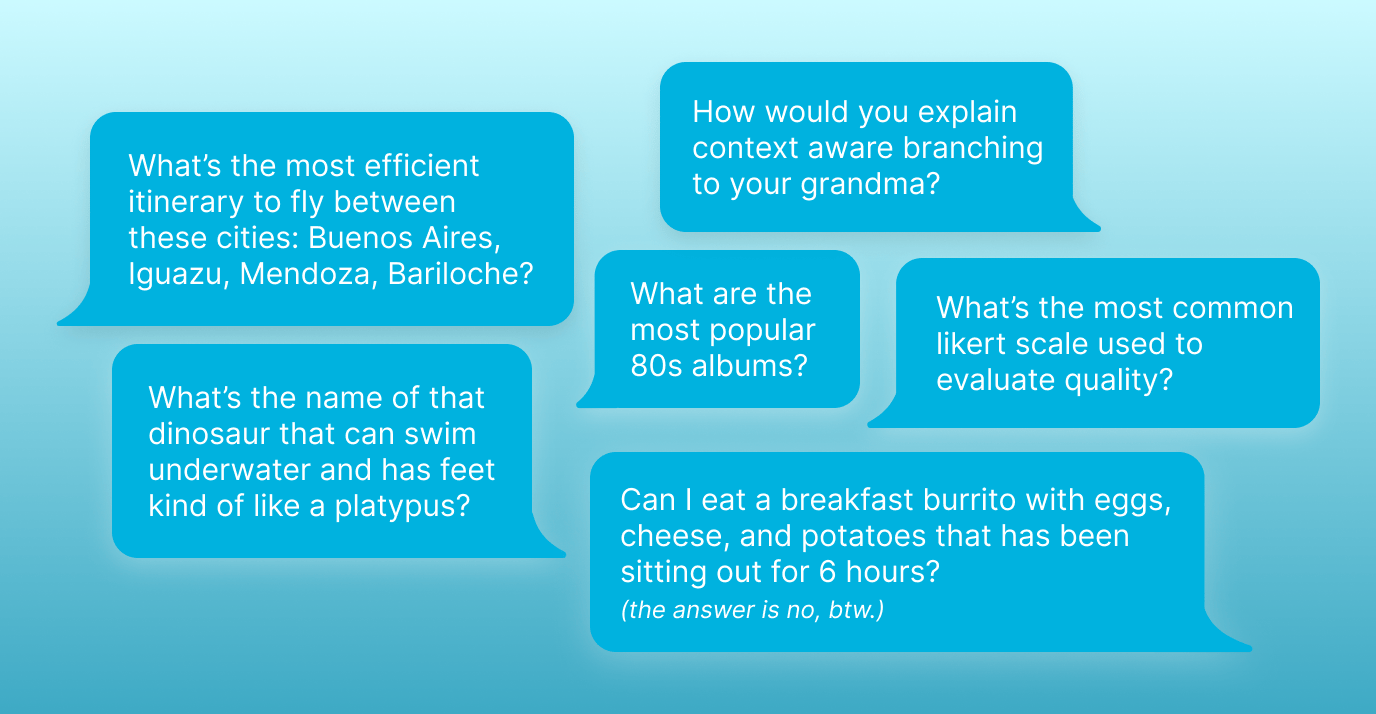
If our team's recent prompts are any indication, we’re using LLMs for… anything and everything.
In seemingly no time at all, AI has gone from an interesting new search bar to a brainstorming partner, a travel agent, and even a food safety inspector. And we have a pretty good hunch that the rest of the world is following this trend.
According to GWI’s survey data of 50+ global markets, over 80% of people have used AI in the past month. Nearly 50%, or roughly 1.6 billion people, have used AI specifically to search for information.
That’s a lot of conversations that are happening every month. The question for brands is simple: Are you part of them?
Because these days, if your brand isn’t mentioned in AI-generated responses, it effectively doesn't exist for a growing segment of the market.
At Nebo, we know that what gets measured gets managed. That’s why the emerging category of AI visibility tools has become an important part of our strategy. They’re helping our strategists understand audience needs, the competitive context, where our clients are showing up, and where there are opportunities to quite literally enter the chat.
But with all that opportunity comes a bit of a challenge. There are hundreds of AI visibility tools on the market today, each with their own claims on capabilities. So how do you figure out which one is right for you? Stage a robot cage match? Ask the LLMs their opinion? (Surely you’ll get an unbiased answer.) Blow your entire marketing budget on subscriptions and hope for the best?
This time around, you can look to us for help getting started.
We selected a handful of AI visibility tools to review and compare as a starting point. The five platforms listed below cover a variety of price points, company sizes, and focuses. They range from specialized startups built purely for the AI era to traditional SEO giants adapting their massive data ecosystems for AI search.
Let’s meet the contenders:
- Profound or TryProfound: Tracks brand visibility and sentiment across LLMs through a topic-based approach. Marketers can gain insights into where and how their brand appears across key topics.
- Gumshoe: Takes a persona-based approach. Brands can see how visible they are alongside competitors for key audience personas across multiple LLMs.
- Peec AI: Takes a topic-based approach, focusing on visibility, position, and sentiment to provide clear and actionable insights.
- Ahrefs Brand Radar: An established SEO tool that leverages its massive proprietary data infrastructure with new AI capabilities to allow marketers to see where their brand is being cited.
- Semrush Enterprise AIO: A well-known, all-in-one platform for SEO and PPC that has added an enterprise-level AI search visibility tool to its offerings. Their tool focuses on helping marketers measure ROI for their GEO efforts.
Now that you know what they are, here’s a breakdown of the key differentiators and limitations of each of the platforms we tested.
| Attribute | Profound | Gumshoe | Peec AI | Ahrefs Brand Radar | Semrush Enterprise AIO |
|---|---|---|---|---|---|
|
Features Capabilities the platform ships with
|
|||||
| Platforms tracked | 10 | 11 | 4–5 | 6 | 4 |
| Competitive benchmarking | Yes | Yes | Yes | Yes | Yes |
| Citation and source intelligence | Yes | Yes | Yes | Yes | Yes |
| Sentiment tracking | Yes | No | Yes | No | Yes |
| Real-user prompt database | Yes | No | No | Yes | Yes |
| Prompt volumes | Yes | No | No | Yes | Yes |
| Query fan-outs | No | No | No | Yes | No |
|
Key differentiators What one tool does that the others mostly don't
|
|||||
| Bot analytics | Yes | No | No | Yes | No |
| Persona-focused analysis | No | Yes | No | No | No |
| Geotargeted generation | No | Yes | No | No | No |
| Citation-focused approach | No | No | Yes | No | No |
| Integrations | No | No | Yes | No | No |
| Brand Radar | No | No | No | Yes | No |
| Revenue and traffic context | No | No | No | No | Yes |
|
Limitations Potential constraints to consider
|
|||||
| Features Locked Behind Paywalls | Yes | No | No | No | No |
| Learning curve | Yes | No | No | No | No |
| Lack of Sentiment Tracking | No | Yes | No | No | No |
| No Traffic attribution | No | Yes | No | No | No |
| Limited Prompt Tracking | No | No | Yes | No | No |
| Tracks Mentions Regardless of Relevancy | No | No | No | Yes | No |
| Restricted Multi-User Access | No | No | No | No | Yes |
|
Intended users Who each tool is the best fit for
|
|||||
| Marketing agencies | No | Yes | Yes | No | No |
| Global enterprises | Yes | No | No | No | No |
| Fortune 500 brands | Yes | No | No | No | No |
| B2B companies | No | Yes | No | No | No |
| High-consideration B2C brands | No | Yes | No | No | No |
| SMBs | No | No | Yes | No | No |
| Startups | No | No | Yes | No | No |
| Already using Ahrefs | No | No | No | Yes | No |
| Already using Semrush | No | No | No | No | Yes |
So which tool wins? Well, that all depends on the job at hand.
If your goal is to understand where and how your brand appears in the vast LLM landscape, consider Gumshoe, Ahrefs, or Semrush.
Gumshoe provides insight into how LLMs perceive brands and who they are trying to target based on the content the brand shares. It’s most useful for gaining audience-based insights.
Ahrefs and Semrush look at all the conversations where a brand is being cited and mentioned. If you’re already using one of these tools to inform strategy, it’s easy to make the jump to their AI offerings. Teams can leverage their familiarity with Ahrefs or Semrush to create LLM strategies that align with current channels.
But what if you already have an approach for improving how and when your brand appears in LLMs? Then tools that block out the noise, like Profound and Peec AI, are a better fit. These platforms allow you to select the specific topics you want to monitor so you can see how your visibility and sentiment are changing over time for the conversations that matter most.
The main difference between these two tools is their pricing structure. Profound was built for enterprise-level companies, allowing brands to track more topics and prompts. However, many of its features require additional spend.
Peec AI was built for small and midsize businesses. It does not require additional spend for certain features, but it’s more limited in the number of prompts and topics that can be tracked.
Still not sure which AI visibility platform to pick? That’s okay. Just remember that no tool offers a complete picture.
AI models change constantly. The prompts people ask evolve. And the platforms measuring all of this are racing to keep up. Take every metric with a grain of salt, and don't be afraid to combine multiple tools if you need to.
And again, the tools we evaluated are just the tip of the iceberg. So many great tools are available for marketers, and the list is only continuing to grow. We hope our findings helped, but sometimes, you just need to get into the weeds to find the tool that fits best for you.
Most importantly, remember that buying a tool isn't the finish line. The story of AI remains unfinished, so make it a habit to see what new tools are emerging. You never know which one will help your brand enter the chat. Or which one knows the most about six-hour-old breakfast burritos.


Comments
Add A Comment